# Data manipulation
library(tidyverse)
library(janitor)

# Spatial data handling
library(sf) # Handle spatial vector data
library(rnaturalearth) # Access Natural Earth map data
library(rnaturalearthdata) # Support data for rnaturalearth

# Visualization
library(ggplot2)
library(ggspatial) # Spatial annotations for ggplot2
library(ggsflabel) # Labeling for sf objects
library(paletteer) # Access multiple color palettes
library(ggsci) # Scientific journal palettes
library(ggtext) # Rich text elements in ggplot
library(shadowtext) # Text with outline/shadow
library(showtext) # Custom fonts in plots
library(ggpubr) # Plot arrangement and publication utilities

# Tables
library(kableExtra) # Styled HTML/LaTeX tablesDesigning a map to visualize the geographic distribution of pandemic- and epidemic-prone disease outbreaks in 2025
Using {ggplot}, {sf}, and a colorblind alternative
data visualization
disease outbreaks
epidemics
pandemics
tidyverse
ggplot2
map
Overview
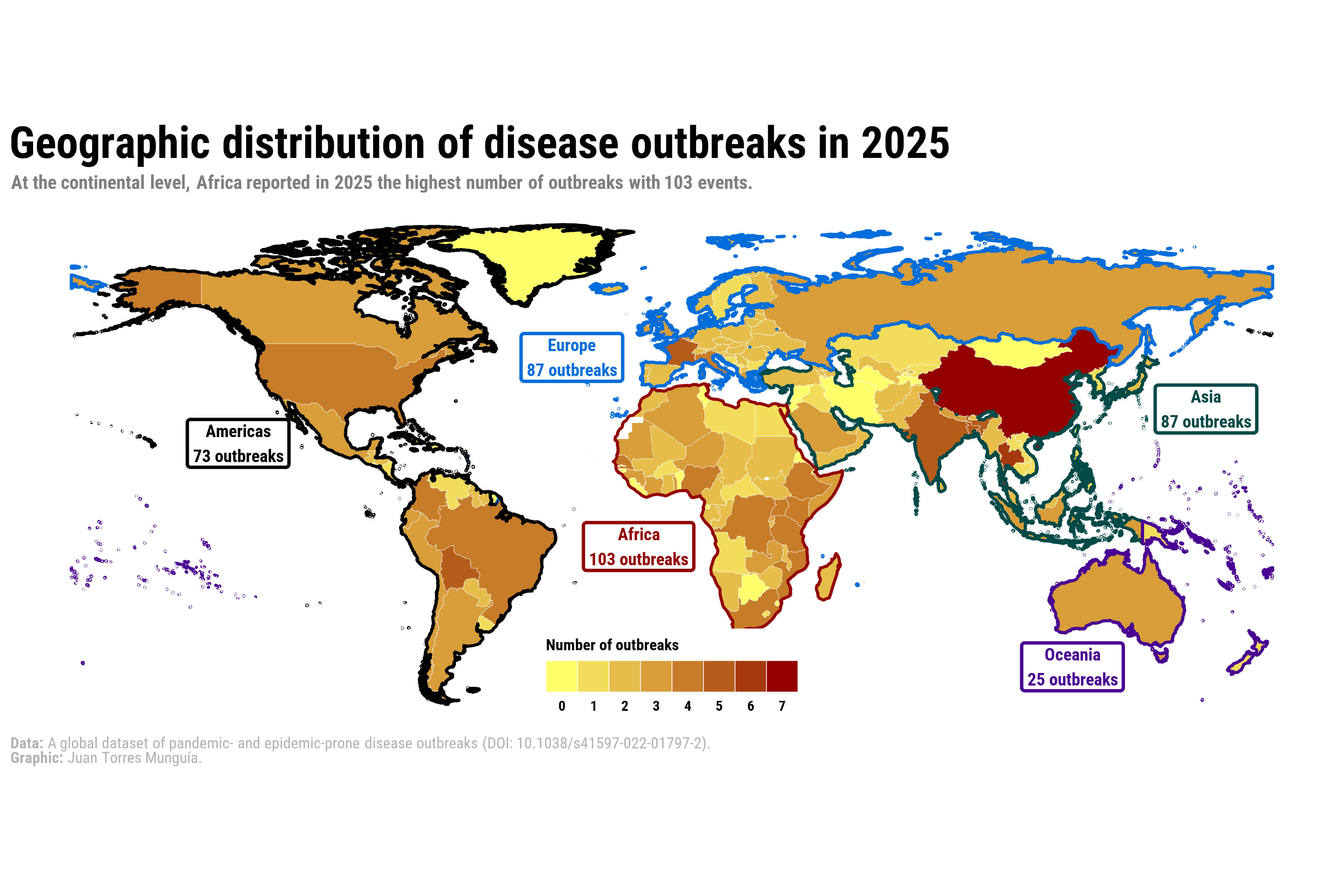
Recently, I built a visualization as part of a paper published in BMJ Global Health, which can be accessedd here1. The goal of this map was to communicate the geographic distribution of disease outbreaks worldwide during 2025. Additionally, I aimed to provide complementary information on the frequency of events at the continental level (suggested during the review process). In this post, I describe the process of reproducing this plot using R.
About the data
The information is sourced from the global dataset of pandemic- and epidemic-prone disease outbreaks2, whose data are freely available at the GitHub repository of the disease outbreaks project.
This global dataset documents more than 3,450 outbreaks across over 230 countries and territories from January 1996 to January 2026. The diseases are classified according to the International Classification of Diseases, 10th Revision (ICD-10), and the dataset contains information on the year, country, and pathogen for each outbreak.
The dataset of pandemic- and epidemic-prone disease outbreaks is also part of the Humanitarian Data Exchange coordinated by the United Nations Office for the Coordination of Humanitarian Affairs (OCHA).
Set-up
To create the world map, we will use the following R packages:
Loading data
The table with the organized data can be downloaded here. This table contains the outbreaks registered during 2025 by country and disease.
outbreaks_2025 <- read.csv("outbreaks_2025.csv")The first five observations of the dataset are shown below:
outbreaks_2025 |>
 slice_head(n = 5) |>
 kbl(caption = "Disease outbreaks during 2025") |>
kable_paper("hover", full_width = F)| X | id_outbreak | Year | icd10n | icd103n | icd104n | icd10c | icd103c | icd104c | Disease | Definition | Country | iso2 | iso3 | unsd_region | unsd_subregion | who_region | DONs |
|---|---|---|---|---|---|---|---|---|---|---|---|---|---|---|---|---|---|
| 1 | 2025AFGA000 | 2025 | Intestinal infectious diseases | Cholera | Classical cholera | A00-A09 | A00 | A000 | Cholera | Intestinal infection due to Vibrio cholerae | Afghanistan | AF | AFG | Asia | Southern Asia | Eastern Mediterranean Region | DON2928 |
| 2 | 2025AFGJ090 | 2025 | Influenza and pneumonia | Influenza due to identified zoonotic or pandemic influenza virus | Influenza due to identified zoonotic or pandemic influenza virus | J09-J18 | J09 | J090 | Influenza due to identified zoonotic or pandemic influenza virus | Influenza, caused by influenza virus strains of special epidemiological importance with an animal-human or inter-human transmission. | Afghanistan | AF | AFG | Asia | Southern Asia | Eastern Mediterranean Region | DON2938 |
| 3 | 2025AGOA000 | 2025 | Intestinal infectious diseases | Cholera | Classical cholera | A00-A09 | A00 | A000 | Cholera | Intestinal infection due to Vibrio cholerae | Angola | AO | AGO | Africa | Sub-Saharan Africa | African Region | DON2928, DON2912 |
| 4 | 2025ALBJ090 | 2025 | Influenza and pneumonia | Influenza due to identified zoonotic or pandemic influenza virus | Influenza due to identified zoonotic or pandemic influenza virus | J09-J18 | J09 | J090 | Influenza due to identified zoonotic or pandemic influenza virus | Influenza, caused by influenza virus strains of special epidemiological importance with an animal-human or inter-human transmission. | Albania | AL | ALB | Europe | Southern Europe | European Region | DON2938 |
| 5 | 2025ALBU071 | 2025 | Provisional assignment of new diseases of uncertain etiology or emergency use | Emergency use of U07 | COVID-19, virus identified | U00-U49 | U07 | U071 | COVID-19 | Infectious disease caused by the SARS-CoV-2 virus. | Albania | AL | ALB | Europe | Southern Europe | European Region | Coronavirus dashboard |
Step 1. Data wrangling
First, it is necessary to reshape the outbreaks_2025 dataset to obtain the total number of outbreaks by country.
The first five observations of the table with outbreaks per country are:
outbreaks_2025_country |>
 slice_head(n = 5) |>
 kbl(caption = "Disease outbreaks by country during 2025") |>
kable_paper("hover", full_width = F)| Country | iso3 | freq |
|---|---|---|
| China | CHN | 7 |
| Thailand | THA | 6 |
| Bangladesh | BGD | 5 |
| Bolivia (Plurinational State of) | BOL | 5 |
| France | FRA | 5 |
I also compute the total number of outbreaks by continent.
Here is the information at the continental level:
outbreaks_2025_continent |>
 kbl(caption = "Disease outbreaks by continent during 2025") |>
kable_paper("hover", full_width = F)| continent | freq |
|---|---|
| Africa | 103 |
| Asia | 87 |
| Europe | 87 |
| Americas | 73 |
| Oceania | 25 |
Step 2. Geographic information
To create the map with geographic boundaries, I use a shapefile located here. This file is imported with the st_read() function from the sf package.
TThis shapefile can be directly plotted using the geom_sf() function of the sf package.
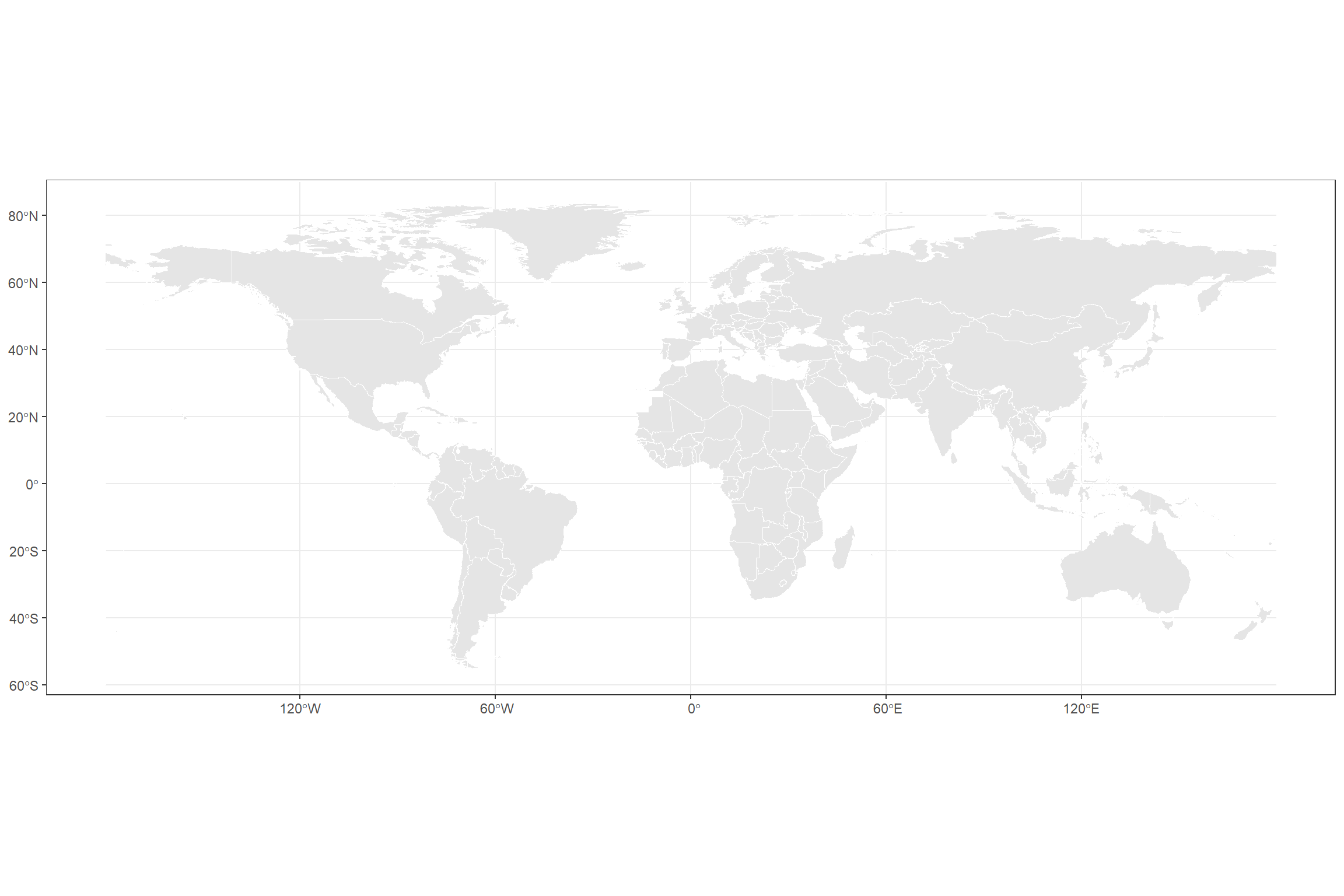
However, this base map does not yet display the frequency of outbreaks by country. To incorporate that information, I merge the outbreaks_2025_country dataset (outbreaks per country) with the shapefile object shpsf.
outbreaks_shp_2025_country <- shpsf |>
 select(-Country) |>
 left_join(outbreaks_2025_country, by = "iso3") |>
 mutate(freq = replace_na(freq, 0)) |>
 select(-Country)
To promote accessibility, I apply a colorblind-friendly gradient scale to represent the minimum and maximum frequency of outbreaks.
ggplot() +

 geom_sf(
 data = outbreaks_shp_2025_country,
 aes(fill = freq),
 color = "white",
 alpha = 1,
 linewidth = 0.1
 ) +

 scale_fill_gradient(name = "Number of outbreaks",
 low = "#FFFF6D", high = "#920000",
 breaks = seq(0, 10, by = 1)) +

 guides(
 fill = guide_legend(position = "top", nrow = 1)
 ) +
  theme_bw()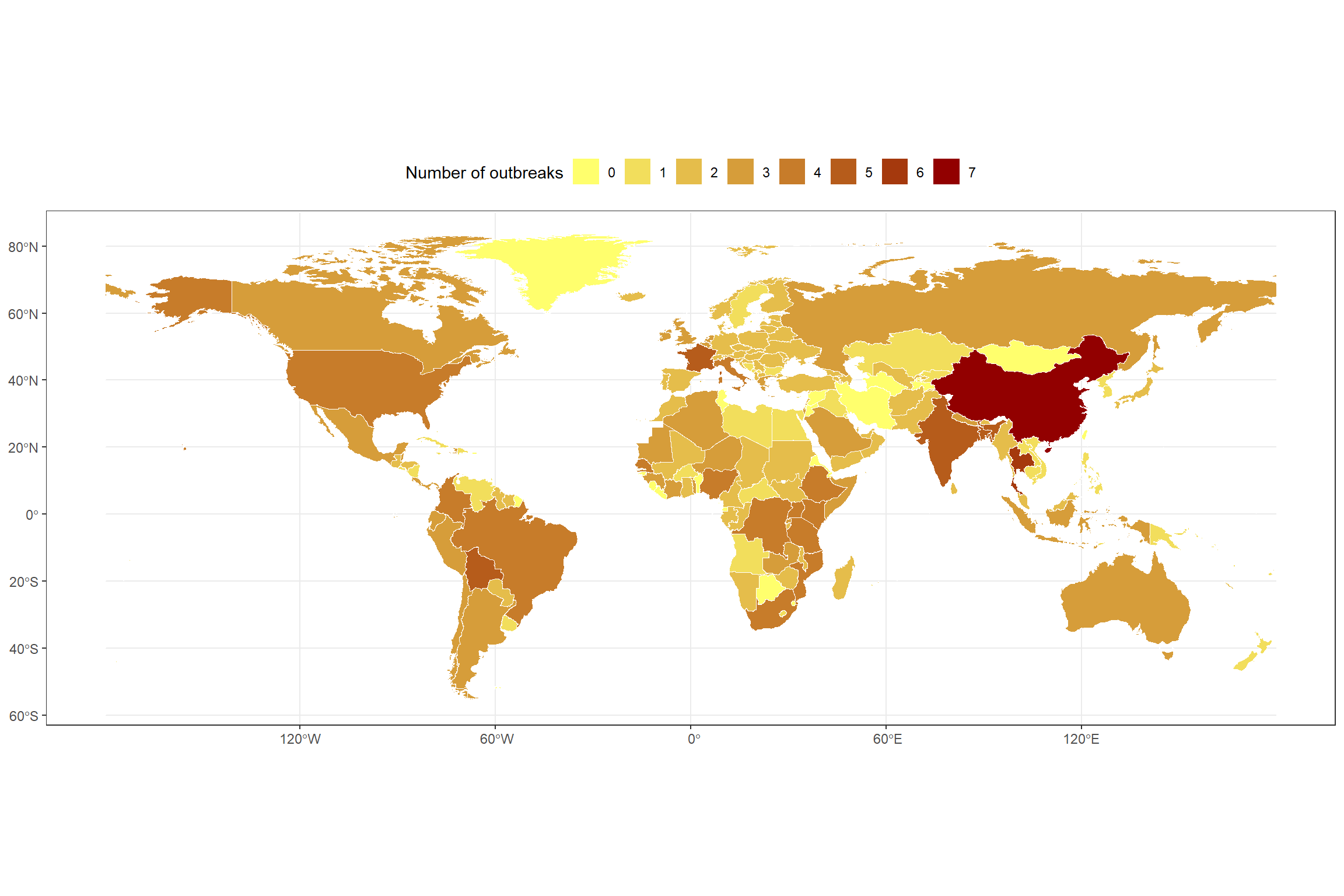
Identifying continents
Next, I define a set of colorblind-friendly colors to assign one color to each continent. A list of discrete palettes with accessible options can be found here.
This produces a shapefile that includes the color assigned to each continent. I will use continental polygons to delimit only the perimeter of each continent. These objects can be obtained either through the ne_countries() function of the rnaturalearth package or by aggregating (e.g., dissolving) the original shpsf object.
# Map of Africa using ne_countries()
shpsf_africa <- ne_countries(continent = "Africa", returnclass = "sf") |>
 group_by(continent) |>
 summarise(geometry = st_union(geometry),
 continent = unique(continent),
 continents_colors = "#920000") |>
 mutate(centroid = st_centroid(geometry))

# Map of the Americas using filter() and group_by()
shpsf_america <- shpsf |>
 filter(continent == "Americas") |>
 group_by(continent) |>
 summarise(geometry = st_union(geometry),
 continent = unique(continent),
 continents_colors = unique(continents_colors)) |>
 mutate(centroid = st_centroid(geometry))

# Map of the the rest of continents using filter() and group_by()
shpsf_continent <- shpsf |>
 filter(continent != "Americas" & continent != "Africa") |>
 group_by(continent) |>
 summarise(geometry = st_union(geometry),
 continent = unique(continent),
 continents_colors = unique(continents_colors)) |>
 mutate(centroid = st_centroid(geometry)) |>
 ungroup()
Given that the color information is stored in the continents_colors columns, I use scale_color_identity() so that the values in that column are interpreted directly as color codes. At this stage, the map looks as follows:
ggplot() +

 geom_sf(
 data = outbreaks_shp_2025_country,
 aes(fill = freq),
 color = "white",
 alpha = 1,
 linewidth = 0.1
 ) +

 scale_fill_gradient(name = "Number of outbreaks",
 low = "#FFFF6D", high = "#920000",
 breaks = seq(0, 10, by = 1)) +

 guides(
 fill = guide_legend(position = "top", nrow = 1)
 ) +

 geom_sf(data = shpsf_continent,
 aes(color = continents_colors),
 fill = NA,
 size = 0.9,
 alpha = 1) +
 geom_sf(data = shpsf_america,
 aes(color = continents_colors),
 fill = NA,
 size = 0.9,
 alpha = 1) +
 geom_sf(data = shpsf_africa,
 aes(color = continents_colors),
 fill = NA,
 size = 0.9,
 alpha = 1) +

 scale_color_identity() +

theme_bw()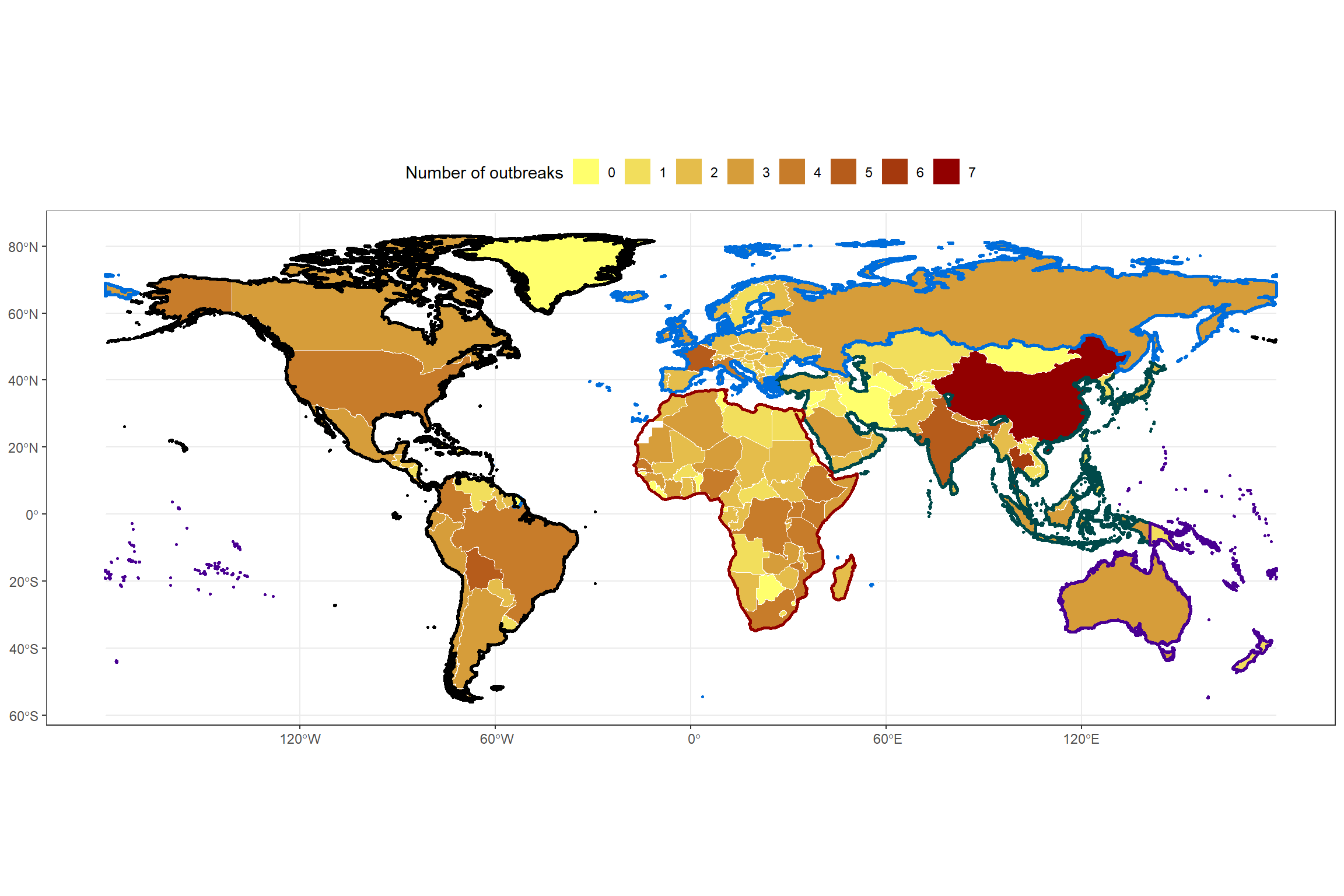
During the review process, a suggestion was made to add text information to the map regarding the total number of outbreaks per continent. Therefore, I created an object containing the continental labels along with their longitude and latitude coordinates for positioning on the map.
continents_labels <- shpsf_continent |>
 rbind(shpsf_america, shpsf_africa) |>
 mutate(lon = st_coordinates(centroid)[, "X"],
 lat = st_coordinates(centroid)[, "Y"]) |>
 st_drop_geometry() |>
 na.omit() |>
 left_join(outbreaks_2025_continent, by = "continent") |>
 rename("freq_2025" = freq)
Using annotate(), I add this text information to the map. In this case, the coordinates were manually adjusted to improve visual placement.
continents_labels <- continents_labels |>
 mutate(lat_y = c(30, 45, -45, 20, -10),
 lon_x = c(160, -30, 120, -130, -10))

ggplot() +

 geom_sf(
 data = outbreaks_shp_2025_country,
 aes(fill = freq),
 color = "white",
 alpha = 1,
 linewidth = 0.1
 ) +

 scale_fill_gradient(name = "Number of outbreaks",
 low = "#FFFF6D", high = "#920000",
 breaks = seq(0, 10, by = 1)) +

 guides(
 fill = guide_legend(position = "top", nrow = 1)
 ) +

 geom_sf(data = shpsf_continent,
 aes(color = continents_colors),
 fill = NA,
 size = 0.9,
 alpha = 1) +
 geom_sf(data = shpsf_america,
 aes(color = continents_colors),
 fill = NA,
 size = 0.9,
 alpha = 1) +
 geom_sf(data = shpsf_africa,
 aes(color = continents_colors),
 fill = NA,
 size = 0.9,
 alpha = 1) +

 annotate(geom = "label",
 fontface = "bold",
 linewidth = 1,
 fill = "white",
 color = continents_labels$continents_colors,
 x = continents_labels$lon_x, y = continents_labels$lat_y,
 label = paste0(continents_labels$continent, " \n", continents_labels$freq_2025, " outbreaks"),
 hjust = "center") +

 scale_color_identity() +

theme_bw()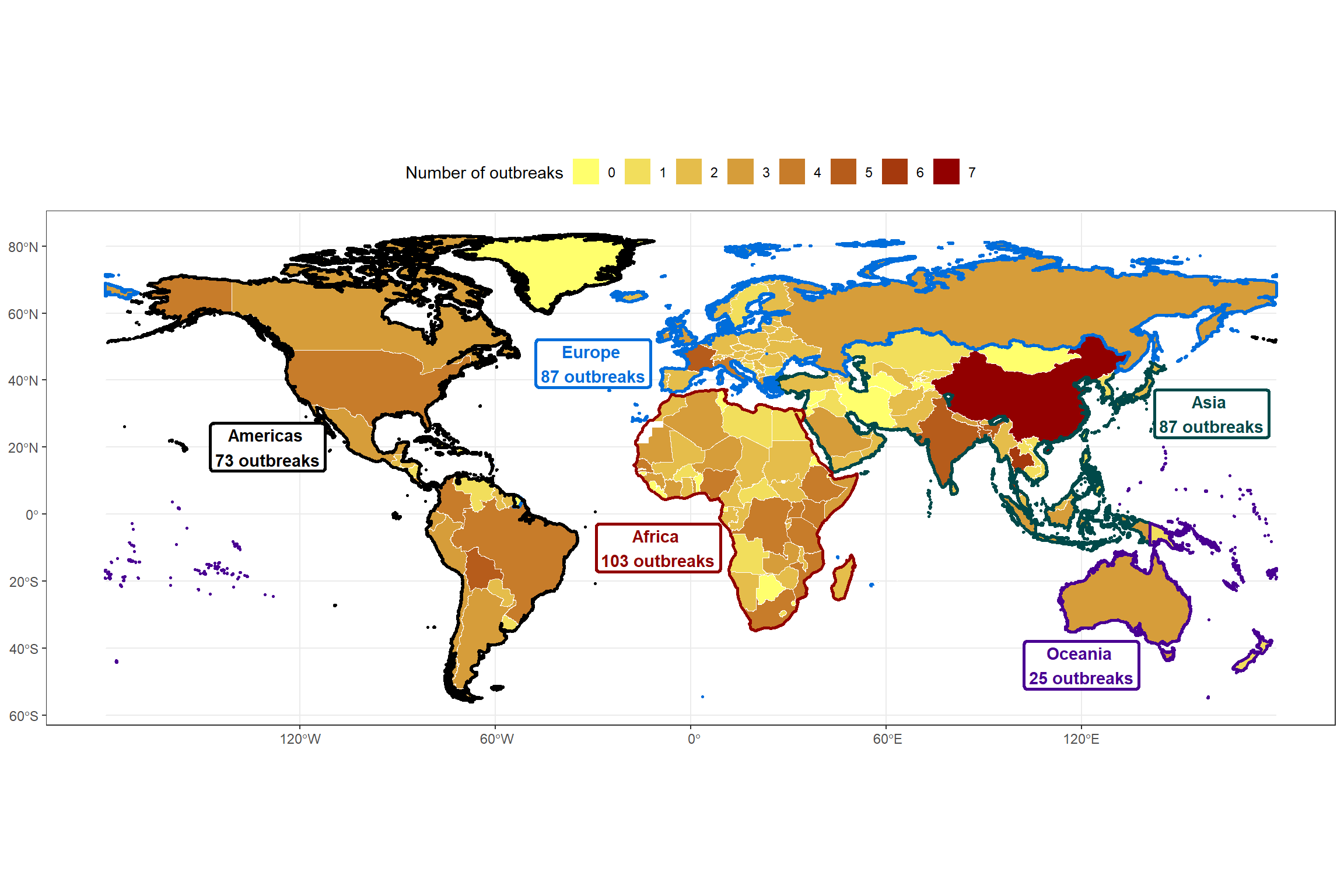
Step 3. Enhancing other visual elements of the plot
First, I define the font to be used in the final chart. I commonly use the font_add_google() function from the showtext package to import fonts from the Google Fonts repository. For the map in this post, I use the Roboto Condensed font.
# Add custom font
font_add_google("Roboto Condensed", "Roboto Condensed")
showtext_auto()
Subsequently, I create a custom theme for the map.
# Custom theme for the map
theme_map_chart <- function() {

 # Introduce the previously selected font
 theme_minimal(base_family = "Roboto Condensed") +

 # Custom theme settings
 theme(
 # Axis settings
 axis.title = element_blank(), # Remove axis titles
 axis.line = element_blank(), # Remove axis lines
 axis.text = element_blank(), # Remove axis text

 # Title settings
 plot.title.position = "plot", # Position of the title
 plot.title = element_textbox(
 color = "black",
 face = "bold",
 size = 28,
 margin = margin(5, 0, 5, 0), # Top, right, bottom, left margins
 width = unit(1, "npc") # Full plot width
 ),

 plot.margin = unit(c(0, 0.25, 0.25, 0.25), "cm"),

 # Legend
 legend.position.inside = c(0.5, 0.10),
 legend.title = element_text(face = "bold", size = 10),
 legend.title.position = "top",
 legend.text = element_text(face = "bold", size = 9),
 legend.text.position = "bottom",
 legend.direction = "horizontal",
 legend.spacing.x = unit(30, "pt"),
 legend.key.size = unit(20, "pt"),
 legend.key.spacing.y = unit(3, "pt"),
 legend.key.spacing.x = unit(0, "pt"),
 legend.background = element_rect(fill = "white", color = NA),

 # Subtitle settings
 plot.subtitle = element_textbox(
 color = "grey50",
 face = "bold",
 size = 12,
 margin = margin(0, 0, 5, 0), # Top, right, bottom, left margins
 width = unit(1, "npc")
 ),

 # Caption settings
 plot.caption = element_textbox(
 color = "grey70",
 size = 10,
 hjust = 0
 ),
 plot.caption.position = "plot",

 # Background and margins
 plot.background = element_rect(fill = "white", color = NA),

 panel.grid = element_blank(),
 strip.text.x = element_text(face = "bold", margin = margin(t = 10), color = "black", size = 5)
 )
}
Then, I define the title, subtitle, and caption of the map.
# Title, subtitle, and caption for the map
title_chart <- "Geographic distribution of disease outbreaks in 2025"
subtitle_chart <- "At the continental level, Africa reported in 2025 the highest number of outbreaks with 103 events."
For the caption, I use rich text by introducing markdown to format specific elements.
caption_chart <- paste0(
 "**Data:** A global dataset of pandemic- and epidemic-prone disease outbreaks (DOI: 10.1038/s41597-022-01797-2).",
 "<br>",
 "**Graphic:** Juan Torres Munguía."
 )
Step 4. Putting together all the previously designed elements
# Verificar el resultado
ggplot() +

 geom_sf(
 data = outbreaks_shp_2025_country,
 aes(fill = freq),
 color = "white",
 alpha = 1,
 linewidth = 0.1
 ) +

 scale_fill_gradient(name = "Number of outbreaks",
 low = "#FFFF6D", high = "#920000",
 breaks = seq(0, 10, by = 1)) +

 guides(
 fill = guide_legend(position = "inside", nrow = 1)
 ) +

 geom_sf(data = shpsf_continent,
 aes(color = continents_colors),
 fill = NA,
 size = 0.9,
 alpha = 1) +
 geom_sf(data = shpsf_america,
 aes(color = continents_colors),
 fill = NA,
 size = 0.9,
 alpha = 1) +
 geom_sf(data = shpsf_africa,
 aes(color = continents_colors),
 fill = NA,
 size = 0.9,
 alpha = 1) +

 annotate(geom = "label",
 fontface = "bold",
 linewidth = 1,
 fill = "white",
 color = continents_labels$continents_colors,
 x = continents_labels$lon_x, y = continents_labels$lat_y,
 label = paste0(continents_labels$continent, " \n", continents_labels$freq_2025, " outbreaks"),
 hjust = "center") +

 scale_color_identity() +

labs(
    title = title_chart,
    subtitle = subtitle_chart,
    caption = caption_chart) +

 # Set the base theme without any background elements
 theme_map_chart()
I then save the file at a high-quality resolution:
showtext_opts(dpi = 320) # Resolution of 320 dpi for high-quality images ("retina")
ggsave(
  "outbreaks_map_colorblind_2026.png",
  dpi = 320,
  width = 30,
  height = 20,
  units = "cm"
)
showtext_auto(FALSE)
Final output is shown below:
References
1.
Torres Munguía, J. A. & Martínez-Zarzoso, I. Global trends of pandemic-prone and epidemic-prone disease outbreaks in 2024. BMJ global health 11, e020708 (2026).
2.
Torres Munguía, J. A., Badarau, F. C., Díaz Pavez, L. R., Martínez-Zarzoso, I. & Wacker, K. M. A global dataset of pandemic- and epidemic-prone disease outbreaks. Scientific data 9, 683 (2022).
Citation
BibTeX citation:
@online{torres_munguía2026,
  author = {Torres Munguía, Juan Armando},
  title = {Designing a Map to Visualize the Geographic Distribution of
    Pandemic- and Epidemic-Prone Disease Outbreaks in 2025},
  date = {2026-02-08},
  url = {https://juan-torresmunguia.netlify.app/blog/posts/world-map-disease-outbreaks-2026/},
  langid = {en}
}
For attribution, please cite this work as:
Torres Munguía, J. A. Designing a map to
visualize the geographic distribution of pandemic- and epidemic-prone
disease outbreaks in 2025. https://juan-torresmunguia.netlify.app/blog/posts/world-map-disease-outbreaks-2026/
(2026).